

Optical and thermal properties
Understanding heat transfer and the interactions between radiation and polymer and composite materials.
- Heat transfer
- Laser–material interactions
Materials & processes
From optical and thermal properties to laser welding and 3D printing: connecting physical phenomena, manufacturing parameters and part performance.
Explore science and engineering courses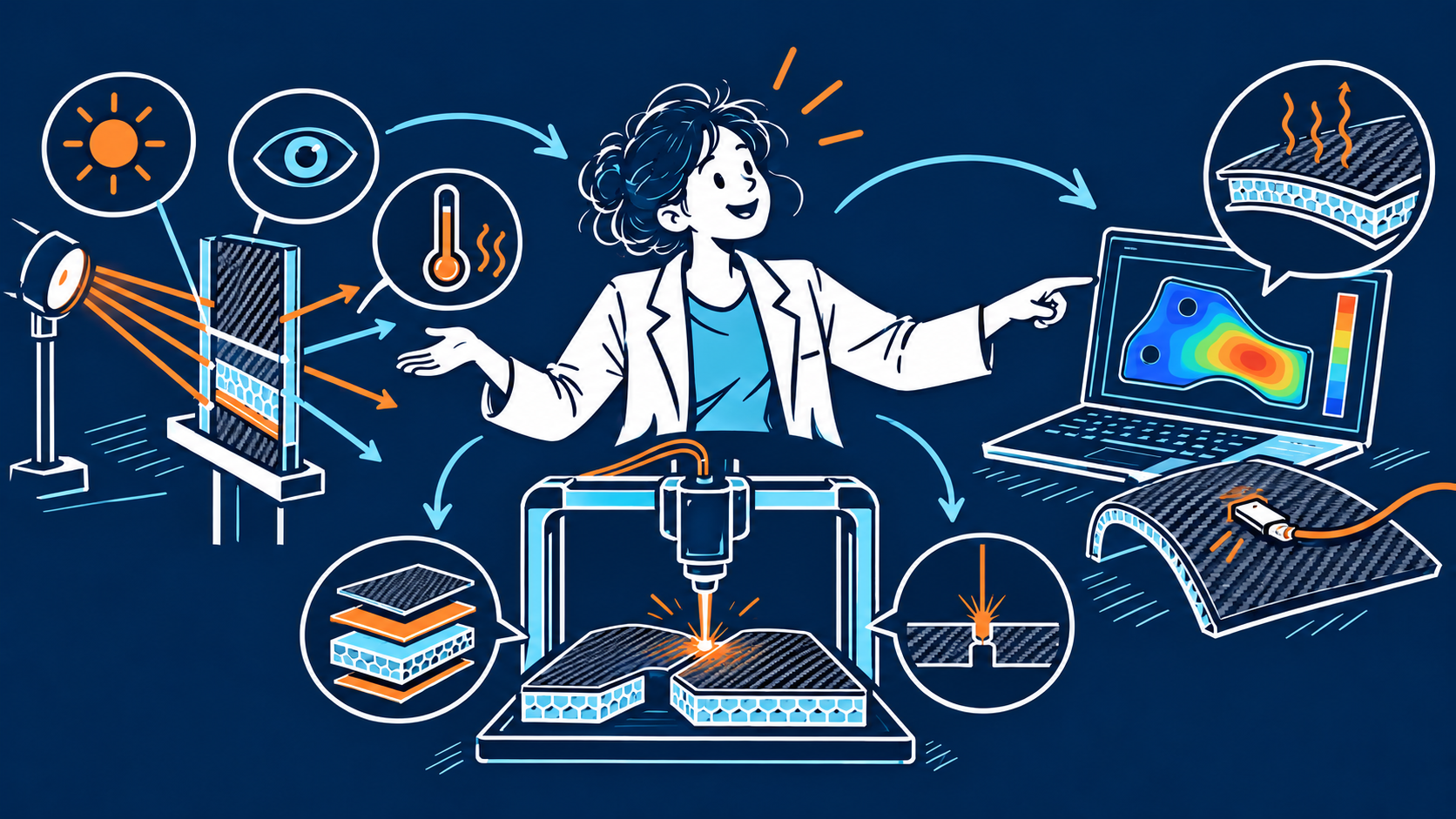
01 · UNDERSTAND AND MASTER
Understanding material properties, mastering the principles of manufacturing processes and linking processing conditions to component performance.
Understanding heat transfer and the interactions between radiation and polymer and composite materials.
Studying manufacturing and joining principles, process parameters and their influence on part quality.
Building models, simulating thermal phenomena and using measurements to analyse and monitor processes.
02 · EXPERIMENT AND INTEGRATE
I support researchers, teachers and professionals in integrating AI into their work. Starting from their needs, I help them identify relevant uses, experiment with practical situations and build an appropriate AI strategy. Understanding the tools, verifying their outputs and retaining control over decisions are the guiding principles of these courses.

Understand what predictive and generative AI can do, recognise their limitations and choose the right tools for a task. Learn to formulate a request, provide useful context and assess an answer before using it.
Explore the literature while checking references, frame a research question, analyse data and develop scripts with AI support. Support research writing and presentation while preserving scientific rigour, traceability and confidentiality.
Design a course, prepare activities, create resources and adapt materials to learners’ needs. Rethink assessment and teach students to use AI thoughtfully without delegating their reasoning.
Start with practical tasks: analyse documents, summarise information, prepare a report or presentation, code a simple tool or automate a repetitive task. Use AI assistants and agents where appropriate, with clear instructions and human validation steps.
Analyse your activity, identify tasks where AI can help and prioritise uses according to their value, feasibility and risks. Test an initial use case, define working rules and measure results to build a realistic action plan.
STARTING FROM YOUR NEEDS
Let’s discuss your work, your audience and the skills you want to develop.